Showing posts with label city life. Show all posts

Sunday, January 22, 2023

Back on the hunt


I have been hunting for about a dozen years and have three deer to show for it, but I don’t regret a minute of hunting. As my friend Steve reminds me, “A day in the woods is a good day.”

This past deer season was my first back in the woods since the pandemic, and in the past decade I had exactly two deer to my name, both button bucks (male deer with no antlers). These were great personal victories but small potatoes in the world of hunting. Some of these years of hunting consisted of only one day on a weekend; another year I went both bow hunting and several days of gun hunting and still came out of the woods empty handed.

The world and personal upheavals of the pandemic and post-pandemic life made it imperative I get out of town and spend time alone in nature. I took the days off from work and hoped beyond hope that I would be able to do it—past years and past jobs I’ve had to cut my hunting trips short and work on days I had planned to take off, an unpardonable sin in the real world if the real world worked right. But this year I managed to do it.

I go hunting in Connecticut. My Connecticut friends got me into hunting and it’s where I keep my shotgun (I don’t have a permit for a gun in New York City—getting a permit for a gun in the five boroughs is more expensive than buying a gun). There are also more plentiful woods in Connecticut.

Heading to Connecticut also means connecting with old friends. I remember when my friend Steve’s oldest daughter was still in utero; now she is acting in films and planning her first tattoo.

The night before your first day of hunting is a poor sleep; memories of past missed deer and the prospect of returning empty handed weigh on your conscious, preventing the restful night’s sleep you want. Alarms set for enough time to get into the wood before legal hunting time, which is one half hour before sunrise.

Hunting makes you get up at a crazy early hour of the morning on your day off from work when everyone else is asleep. I found it’s possible to forgo the morning coffee. The frigid air and the urge to get out hunting is an effective wake-up of its own, and the surge of adrenaline at seeing a deer (or what you think is a deer) is enough to keep you awake through the day.

After having some quick snacks for breakfast and drinking a can of soda for the caffeine, I dressed and forced my feet into hunting boots, gathered my gear, and headed out. I first had to defrost my truck—first frost of the season and I didn’t think I would be scraping my windshield that early into November but it was New England in the fall. Another pickup truck sailed by on the dark road as I was getting the truck ready—Are they going hunting also? Will they get a better spot by the side of the road, and do they know my favorite hunting spot? My fears were unfounded. I drove to the entrance to the Cockaponset State Forest and was the first one there. I walked into the woods alone, wondering how odd a spectacle my truck with New York license plates would be for local residents driving by or heading into these same woods to hunt.

Out in the woods, it’s sometimes hard to focus on finding deer so early in the morning and not marvel at the beauty of the forest in the early morning, pre-sunrise light. Human beings are not meant to be boxed in by glass and concrete. We are of the Earth, and we diminish ourselves the more we remove ourselves from it. Being surrounded by natural beauty is a human need; just being within view of a river can make sitting in a city office much more bearable.

Being in the woods is the drastic reset your body needs. But the marvel at the natural world wears off a bit as the sun comes up and the imperative to get a deer kicks in. This is why you are here: you don’t want to return empty-handed even if you are getting much-needed time in the woods.

When you hear gunshots going off around you—some closer and definitely in the same state forest, some farther away on private land—the urge of the hunt surges again, and you get more restless. This is where I have erred in hunting. Staying in one place for so long and not seeing any deer gets the wanderlust going, and powers up your self-doubt on how well you’ve selected your hunting spot. Did I pick the right spot? Why are other people finding deer so close by and none are coming here? Did I make too much noise? Are there better hunting grounds elsewhere I can get to?

On my second day of hunting, I caught this wander bug and decided to see if I could find better places to hunt. The upside is that I found a good spot; the downside is that I walked around too much and the one deer I saw that day was one I scared away by hauling myself through the leaf-crunching woods. I also discovered an old illegal hunting camp set up on public land, a big no-no. It looked like it hadn’t been used for a while, with man of the structured dilapidated or filled with water and leaves.

Finally settling in on a spot at the end of the second day, I heard the sound of running feet and saw a dog chasing a deer through the woods. A large white dog was barking and giving chase, and my heart raced as I aimed at the deer that was heading my way. As it got closer, I realized that this fast brown animal was in fact another dog; the sound of its collar jingled as it got closer. I lowered my shotgun and cursed whatever idiot owner let their dogs loose in the woods during deer hunting season. The rest of hunting that day was quiet save for the sound of those dogs, who likely chased away any deer that would have come my way. That day was another wash.

You realize how much of a city person you are when you go out into the country and do country things. What do you mean a supermarket closes at 9 p.m. on a Friday? Closed on Sundays? Are these people insane? I drove to Robert’s Food Center, a supermarket where I had my first on-the-books job for less than $4 an hour (not as horribly cheap in 1987) only to realize that they carried no Pepsi products at all, so I had to drive to downtown Madison’s Stop & Shop to stock up. I later messaged Robert’s to ask why they carried no Pepsi but have not yet heard back.

Every time I go hunting, I’m reminded of the sweat and grit and cold that goes into it, and how I quickly forget about this rough unpleasantness the rest of the year. Before I made hunting a regular event, I had a romanticized view of it. I dreamt of expansive adventures where I would collect large trophies and other relics from my travels in the wild. I fantasized about being some kind of contemporary Hemingway and shooting exotic game and then retiring to my tent to sip brandy and draft powerful novels. In reality I mostly return with sore muscles, cuts and scrapes from brambles and thorn bushes and a pile of muddy clothes.

On my last day I parked myself at a spot I had found earlier that I named Anunnaki Rock. “Anunnaki” is a name given to a race of extra-terrestrials that conspiracy theorists credit with helping build the pyramids or creating or cloning human life on our planet. This spot features a large boulder shaped like a large alien’s head. A tree has fallen on it, so it appears that the alien is being smacked in the face with a baseball bat; a sad but fitting metaphor for how we would treat intelligent life on our planet.

When I got there, I kicked leaves out of my way so I could pace back and forth soundlessly throughout the day. There was a natural ledge I could sit on and still get a nice, elevated view of a good swath of woods, but my area of coverage was greater standing and I stood and paced around most of the day.

The day remained cold and at certain times of the day I heard gunshots going on elsewhere in the woods; it sounded like everyone was having better luck than me. I paced relentlessly but quietly. Around 2 p.m. that afternoon, Steve texted me to ask if I’ve seen anything. I had not, and told him that I was considering coming out of the woods early and getting a head start on the drive home. Steve said he was going to go into the woods for the last few hours of hunting. I figured that if Steve was going to hunt until the end of the day (hunting ends at sunset, which is usually around 4:30 p.m.), then I would hunt also.

A half hour later I heard one of those blasted dogs again, I kept looking in the direction that the barking was coming from, on the chance that the barking was sending a deer my way, and if not then maybe to give its owner a piece of my mind if they were heading my way.

A deer bounded in my direction from the sound of the barking, and I raised my shotgun. It saw me and stopped short. I found it in my scope and pulled the trigger.

A shotgun blast is loud and unless you go shooting frequently you do not get accustomed to it. The deer took off and ran past me. I thought my race to get zeroed in on the deer again caused me to miss, I watched the deer head past me about 30 yards and then come to a stop. The buck stood there for a second and then fell over.

A sense of glory and relief washed over me. My hours of cold frustration in the woods had paid off; I had done it! I got a deer.

It’s customary to give the deer time to make sure it has died. That is both respectful and practical. Respectful in that you let the animal be alone in its last moments, surrounded by the woods rather than probing hands of our alien human race. Practical in that if you approach a deer that is dying, it will sometimes get up and run away for a bit in a panic fueled by a last rush of adrenaline, or, worse yet, gore you with its antlers. After at least 10 minutes of the deer not moving, I slowly made my way toward where he had fallen. Approaching it from the back (the customary practice to avoid startling a deer that may still be alive), I confirmed it had died. It was an antlered buck that would be a four-point deer but one of its antlers had been damaged. Nothing you would have mounted but it was another buck, and I was proud of getting it. I set about field dressing it.

Again, a reminder from my friend Steve about the post-shooting part of the hunt: “Everything from pulling the trigger to eating it on a plate is a pain in the ass.”

Field dressing a deer means removing its internal organs. It had been six years since I had shot my last deer, which was only the second one I ever got, so I still feel new to field dressing. But despite my confusion and frustration, I managed to get the deer field dressed and was ready for the worst part of hunting: the drag.

I was deep in the woods on the far side of a ravine split by a stream. The majority of my drag was uphill, and I also had to carry my shotgun and backpack out of the woods also. The drag started fine since I was going downhill, though there were brambles and prickers that could not be avoided. I had to drag farther than I thought in order to get to a part of the stream that was shallow enough. I carried over my gun and pack first—the backpack is blaze orange so easy to see—and then brought the deer. The deer got heavier since it now had water weighing down its coat. I was going uphill now. I took the gun and backpack and scouted ahead a bit, finding the path of least resistance, then walked back and dragged the buck to my gun and backpack. Through more brambles, scraped by a low-hanging tree branch, and over a stone wall, each more tiring and frustrating than the next. I kept this pace up and took my time so as not to throw out my back or trip and fall (dragging a deer out of the woods with a broken ankle or sprained back wasn’t going to happen) and feeling every one of my 50 years.

Throughout the drag I banked on things becoming much smoother once I finished the uphill portion and found the main path that I would take to get back to my truck. A deep sense of relief washed over me when I reached this path. There was still a long way to go. I changed methods again and put the backpack on my back, taking an antler in one hand and the shotgun in another and went faster that way. That became very tiring and then impossible to navigate around the ruts and puddles that dotted the path. I kept taking my time and taking frequent breaks. At one point while dragging the deer to the next stop I tripped over a small rock and fell backwards. It was past sundown now. It was 2:30 when I shot the deer, it was close to 5 p.m. by the time I got the deer to my truck, with my friend Steve helping me drag the deer the last 20 yards or so. We got the deer into my truck and headed back to Steve’s house.

Hunting has been the adventure I need more than the adventure I had envisioned as a younger person. I had dreamed of hunting as a manly affectation that I would indulge in on my way to being a literary icon, surrounded by dashing young flappers and a devilish halo of cigar smoke. I wound up downing Diet Pepsi in my friend’s shack, taking puffs of a store-bought cigarillo, but could not have felt better about life.

Here's to the hunt.


Wednesday, December 18, 2019

A grateful New York City bids farewell to Two Toms


Two TomsRestaurant in the Gowanus section of Brooklyn announced in October that after more than 70 years in business, it is going to close its doors at the end of this year.

Founded in 1948, Two Toms is an institution unlike any other restaurant that is open to the public. It’s a modest and understated very simple dining room in a relatively narrow space, with a street-facing entrance in the front and a kitchen in the back. The food is outstanding and often served family style in large groups, at least that is their specialty. I’ve seen regular tables order off a menu there. But every time I’ve been there it’s been a large meal with several courses.

An Italian restaurant with great pasta and shrimp parmesan among other dishes, it’s most famous for its pork chops, that are enormously thick and juicy and will count as one of the most memorable meals you ever have. I rarely take photos of food, but I had to stop and takea photo of my meal while I was working on one of the pork chops there last year.

I became aware of Two Toms after meeting a group of friends for dinner there several years ago. The restaurant then was known mostly to locals and has a distinct following among law enforcement. Myfriend Poppy knew of Two Toms from his time working in Brooklyn with the NYPD and it became a regular spot for people we worked with at JFK Airport to hold meet up.

The several courses are conducive to long dinner conversations, the perfect setting for families and old friends. Its unassuming décor adds to its appeal. You are at home there. You can help yourself to beer or soda or bottled water from the refrigerator that is there in the dining room. You knew there was going to be another amazing course coming soon. You didn’t have to worry. Everyone was going to have a good time, and no one was leaving hungry.

When Two Toms owner announced in October that the restaurant would be shutting its doors at the end of the year, its many fans were in shock and jumped into action. Loyal customers flooded the restaurant with so many reservations they began opening extra days and even still they were quickly booked through the end of the year.

My group of friends that took to meeting at Two Toms worked to get a gathering together, but by the time I called to make a reservation, all bookings were gone. I asked the woman I spoke with on the phone to please let me know if any openings at any time for any number of people would be available—if the usual group couldn’t make it at least a few of us would be able to give a final farewell to the place. Social media is alight with tributes pouring in, and legions of New Yorkers who managed to get a reservation are paying their respects.

Two Toms achieved a devoted following because it does what it does best simply and without pretention. It doesn’t boast a celebrity chef or change its menu to some trendy fusion to match the hip flavor of the month. It also refuses rest on its laurels and scream to the world about how long it has been around either. It has stayed true to its roots and has never let up.

New Yorkers will continue to search for the kind of honest authenticity embodied by Two Toms and we owe the legendary eatery a debt of gratitude.

Thank you, Two Toms!  

Wednesday, September 18, 2019

The importance of city sunsets


This weekend was a typical blur for a person with an office job and small children. There was per usual a mountain of house chores to do, events to take the children to, and hours of each day dedicated to the day job, as our day jobs spread their tentacles into every aspect of our lives. On top of that add grocery shopping.

Sunday I took one of my daughters with me while we went grocery shopping. She helped me find things in the store and took pride in helping me load things into the cart. We navigated the crowded aisles and found everything on our list (with some extra popcorn and coffee thrown in for good measure).

We were running down the clock toward dinner time and I knew I had a full wagon of groceries to get upstairs and away before either I or my wife had to make dinner.

We made good time and were parked outside our building a few minutes after I had returned our shopping cart. I sat at the driver’s seat for a few minutes, trying to calculate in my head the things I needed to accomplish in the next few minutes: getting my daughter out of her car seat, loading up the groceries, cleaning out part of the car quickly between those two steps, getting the groceries away, making dinner, getting logged back in at work—

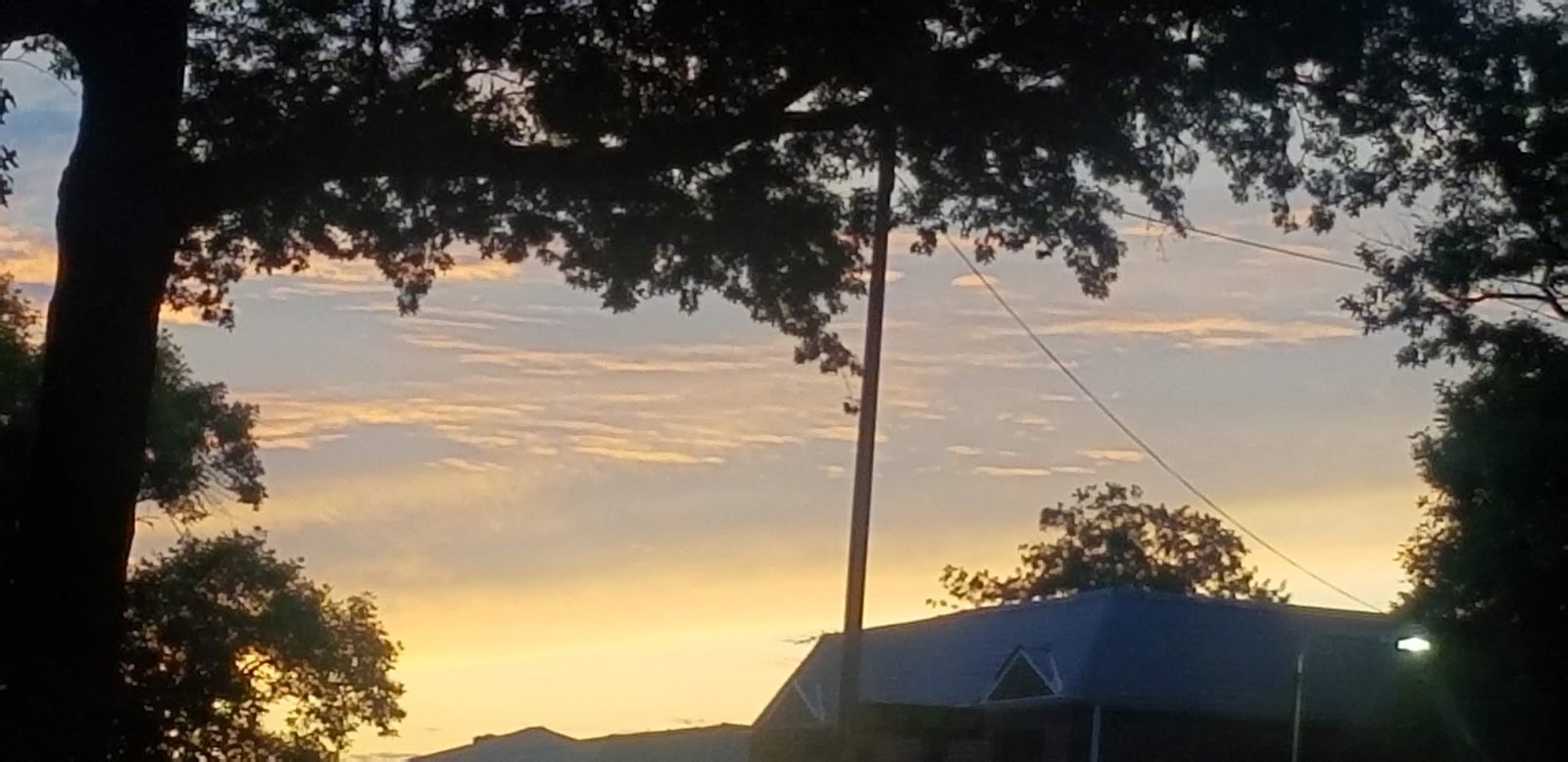
“Daddy, look at the sunset,” my daughter told me.

Through the trees and the power lines and shadows of nearby buildings, a patch of brilliant dusk sunset filled the sky with its pastel vision. It had been there the whole time, going unappreciated by me.

It was a testament to the excellence of children. They have not had years to become jaded or distracted with the compounded stresses of the mundane. It was a reminder of how grateful I ought to be for my family and my life. 

When we think of New York’s beauty we usually picture its stunning skyline, its aged paving stones and its tributes to achievement wrought in stone or glass; the urban landscape is beautiful but almost always bears the mark of a human hand. Even the most gorgeous parts of our most popular parks were put there by design.

This outlook often neglects the natural beauty that surrounds, us, and the fiery sky of an autumn sunset has few rivals of natural scale in our Gotham’s vision.

And so often in the execution of our ambitious dreams, the wonder of life itself gets lost in the shuffle. Having kids won’t bring the same reward if we can’t pass on an appreciation of beautiful things. Without the ability to stop and look at the greatness around you, are we succeeding in life at all?

I opened the passenger door so my daughter could get a better look at the brilliant sky, and took a photo so I could remember this and show her later. I made a silent vow to remember our sunsets, and make the time to take in the natural beauty that surrounds us, even in the densest cityscape.


Saturday, September 07, 2019

A journey through the MTA’s lost and found


Earlier this summer, I arrived home late on a Friday night—late these days meaning after 8 p.m.—and was taking things out of my pockets after a long day. When I reached into my right front picket, I came to the realization that I did not have my wallet. My stomach tied in knots and I cried out in frustrated desperation. I knew it had been in my pocket; there would be no deus ex machina miracle of finding it in my bag or in another pair of shorts.
                
I knew that it most likely fell out of my pocket on my commute home. I had just gotten off the express bus—this bus was still on the road and someone could radio the driver! I immediately picked up my smart phone and dialed 311 for citywide information. The 311 operator would be able to connect me to the right person. The 311 operator transferred me to 511, which is the information number for the Metropolitan Transportation Authority (MTA).

After a few more transfers, I spoke with someone I was told could help me. I gave them all the information I had. I was on a QM20 bus and was picked up from 6th Avenue and 42nd Street in Manhattan at approximately 8:40 p.m. and was dropped off at Union Street and 26th Avenue in Flushing, Queens at approximately 9:30 p.m. This driver was probably still on their route and with the information I had given them someone should be able to get in touch with the driver ASAP!

But nosuch luck. The person on the other end of the line said they could not do anything unless I had the bus number. Without the bus number, they could not contact the driver. Seems a bit ridiculous. If this had been a more serious situation and people’s lives depended on finding the bus, there would have been a catastrophe.

I was asked to call back the next day after the bus had gone back to the depot and the driver may have turned in the wallet. It was a small wallet, one that held only cards. I was not out any cash, unless someone was going to town with my debit card.

I started to call credit card companies and my bank to have holds put on cards.

The next day I called the depot. Nothing.

I called back the next day, and called back later in the day again. Nothing still.

I went through with canceling and replacing my credit cards and ATM card and replacing my driver’s license.

By Monday, there was no funny business on my cards and new ones were on the way. I printed out a temporary driver’s license and ordered a new card wallet that came with a money clip. My card wallet needed replacing anyway, and this was a chance to pare down the stuff I carried with me everywhere.

A few weeks later, the same day my new driver’s license arrived in the mail, a notice from the MTA Lost & Found arrived in the mail.

“An article which contains your name and/or contact information was found and turned in to the MTA NYC Transit Lost Property Unit,” the notice began. It instructed me to report to the unit’s office at the 34th Street subway station at 8th Avenue in Manhattan. If I did not claim my property by Nov. 3, “it will be deemed to have been abandoned and you will have forfeited your right to claim it.”

The next day I brought that notice and my newly replaced driver’s license to a hidden-in-plan-sight pocket of the 34th Street subway station in Manhattan. It took some searching and asking to find the lost and found office, which is beneath the tracks of the A, C, E subway lines and without any signs leading you there except in the immediate vicinity. It’s within the subway system, so if you arrive by some other means or exit the subway before you find it, you’ll have to spend another subway fare to reach it or get a helpful MTA worker to let you in.

A small sign points the way to a set of double doors painted in celebrationof the many objects found in our transit system. The office is open odd hours—and completely closed weekends and holidays, a travesty in a system that runs 24 hours—but luckily is open until 6:30 p.m. Wednesday and Thursdays.

Inside is a small room with a very low ceiling. I’m five feet eleven inches with my shoes on, and if I had extended my arm fully above my head I would have punched a hole in the drop-down ceiling. There is a metal bench to sit on, a small counter to stand and fill out paperwork on, two old-looking computer terminals, and a thick window above a pass-through door through which one may conduct business with the MTA workers on duty.

I arrived as a worker emerged from another set of doors to hand someone some paperwork, and she took my notice and ID and disappeared in to the bowels of the lost and found. The woman who was there spoke to someone at the window and was told to check back about her property later. She left and another woman arrived to ask if a book she lost on the subway was found. She was told no and to check back later; she left. Another man arrived and looked through his paperwork to check on a claim, and while he was speaking with someone another woman arrived to check on some property she had reported missing.

A worker arrived at the thick window with my wallet. It was a different worker than I had given my notice to; it was a rotating staff of workers answering questions and handling forms. He told me to sign my name on another form and write my address the same way it appeared on the notice in the mail. He opened the door to the silver box under the window and placed a clip board inside, and when he closed his door I opened mine and filled out the form.

A minute later, the same exchange reunited me with my wallet. It looked a little worse for wear, but nothing was missing. Everything was there: my license, my ATM card, my MTA MetroCard, even the coupon for a t-shirt at the zoo. I excitedly took an inventory of my wallet while my fellow transit visitors looked on amazed.

“You give me hope,” said the young woman sitting on the bench, hoping her property would be returned.

I thanked the worker and wished the other people in the office good luck, and went back out into the bustling station. For me, lost and found had worked out well.

Thank you to the Good Samaritan on the bus who turned in my wallet, and the series of honest MTA workers that made it possible for me to get my property back. For me the stars aligned this time.

Tuesday, August 20, 2019

FNO Flushing Fantastic, daytime festival edition


Despite the popularity of some parts of Brooklyn, our collective dialogue around New York City remains excessively Manhattan-centric. New Yorkers will still say “the city” when they mean Manhattan, even though the five borough boundaries of our city have been in place since 1898.

And New York City is so large that telling people what borough you are from will not cut it. No one actually from Manhattan would introduce themselves as being from Manhattan unless they were in a very borough-specific conversation. Each of New York City’s boroughs is a tapestry of neighborhoods, and it is these neighborhoods that are the lifeblood of life in NYC.

Queens is New York City’s largest borough and among its most well-known neighborhoods is Flushing. This weekend, local residents are showing off the neighborhood’s many attractions Saturday at FNO 2019: FlushingFantastic.

FNO stands for “Flushing Night Out” as past events have been held at night, but this festival is going to run from 12 noon until 6 p.m. and is going to be at historic St. George’s Episcopal Church, right in the center of downtown Main Street a short walk from both the 7 train and the LIRR.

Flushing is known as a destination for Chinese cuisine, and people will come from all over to sample some of the great restaurants, food carts, or food court stalls that make this neighborhood unique. But there is much more than Chinese food, and the GreaterFlushing Chamber of Commerce is promoting the neighborhood as an international melting pot, though admittedly one that is heavily Asian. I often point out to people that among the best dining attractions in Flushing are 24-hour Korean restaurants such as Kum Gang San and Noodle Flower, where you can barbecue an awesome assortment of meat right at your table at two o’clock in the morning if you are so inclined.

The Greater Flushing Chamber of Commerce also notes that the event is designed to give a boost to local businesses and entrepreneurs that are competing with large franchises. Downtown Flushing has seen a boom in construction of high-rise condominiums and the rising price of real estate has made life harder for small businesses throughout Queens and five boroughs.

“Flushing, NY is the crossroads of the world -- where you can find amazing culture and people from around the globe,” the chamber says in its event notice online. “We want to celebrate the unique food, fashion, and music found here as well as help the small businesses and entrepreneurs who are struggling to make ends meet. Over the past decade, rising rents and major development projects have threatened to displace the small mom-and-pop stores who invested their blood, sweat, and tears into making our neighborhood prosperous.”

Flushing Night Out has been held at various locations, centered on the downtown area. The first one I attended was on the campus of Flushing High School, and it was a memorable event, even for cynics like me that hate crowds.

It was at my first Flushing Night Out that I was introduced to Karl’s Balls, a food stand of traditional Japanese takoyaki balls—those are octopus balls inside a doughy sphere that are cooked on an egg-shell like grill. Go to Karl’s Balls because it’s an ingenious name and you may never stop joking about wanting to put Karl’s Balls in your mouth. But all joking aside, the takoyaki balls are extraordinarily delicious and Karl himself—Karl Palma—is a celebrated chef who has been featured on the Cooking Channel among other accomplishments.

While Karl’s Balls may not be at this FNO event, there is going to be a smorgasbord of amazing food, from Ecuadorian cuisine to Japanese ramen to craft beer and gourmet ice cream. You have no excuse to leave hungry. The organizers require all the vendors there to have items that start at $5 or less.

FNO also features live music, crafts, and other cultural interests. This Saturday will feature HarmonycMovement, a city-based dance troupe steeped in K-pop and Korean culture.

And at the Flushing Queens MacaroniKid booth, they will be giving away protein bars for free (full disclosure, my wife Emily GriffinSheahan runs our local Macaroni Kid web site and will be manning the booth at the event – tell her I sent you!).


Thursday, March 14, 2019

The gritty oasis of Liberty Place


The Financial District in New York is known for large office towers of glass and marble facades of old buildings. It is considered the epicenter of the financial world.

Many of the large banking institutions that comprise the symbolic “Wall Street” are located in midtown now. And very little actual stock trading happens on Wall Street itself. Most actual stock trading happens on giant data servers in New Jersey. But the name is going to stay and new banks will move in to replace the old ones.

There is a charm to lower Manhattan that is missing from midtown and other parts of the island. The streets retain the narrow dimensions of the early Dutch settlers, and now they are lined with tall buildings instead of brick homes. The chaos of the streets is part of what makes it different. You have to know where you are going, and the logical numerical grid of midtown is choked off for good farther uptown at Houston Street. South of there, you have to know where you are going.

Lower Manhattan retains some of the old world charm of the early settlers, even though Manhattan today looks nothing like it did when it was New Amsterdam. You can still see remnants of Revolutionary War history and the days of our nation’s founding. If you are close enough to Battery Park, you can wander away from some of the tourists to the KoreanWar Memorial or one of the gardens that are quieter, or see working beehives.

An additional charm to lower Manhattan generally and the Financial District in particular is the scattered network of small alleyways. When I first started working downtown, I had more time to take walks on my lunch hour and whenever I came across a small alley I had not experienced before, I had to walk down that alley. It still seems a sin not to.

Near where I work now is one such alleyway: Liberty Place. It’s among the alleys that populate lower Manhattan and serve as secluded getaways that are enticing for midday walks.

ForgottenNY points out that LibertyPlace used to be called Little Green Street and dates to the era of the early Dutch settlers. People who walk or drive on the extremely narrow, one-way street are traveling where there once was a graveyard and Quaker meeting house.

I make a point to walk down Liberty Place whenever I can. It’s an oasis of old New York City grit in a scrubbed land of tourists and high finances. I often smell skunk weed and see people taking a break from work. The people who linger there are sharing a joint, drinking discreetly, or making a phone call away from the usual noise and bustle of the New York workday.

And even though I don’t drink or smoke weed I walk down this alleyway feeling I am among my people. I also would rather loaf and feel at ease and spend my days enjoying the random beautiful madness of our city streets rather than sit at a desk and answer emails for hours. I too should have stayed a rambling, impoverished poet looking for eternity in the eyes of strangers.

Liberty Place is just that, a place we can seek a breath of liberty even within a shadowy alleyway. I try to make it part of my daily routine, another way to get through the everyday and be a tourist in your own city.  

Wednesday, October 17, 2018

An afternoon in the pumpkin patch


It finally feels like fall. After having days that topped 80 degrees in October, it was a relief to have days where temperatures stayed mostly in the 50s. This past weekend it was time to get out and enjoy the weather somehow, and I was on a mission to keep my children entertained while my wife prepared our home for more entertaining.

A Pumpkin Patch and other attractions were available at the Queens Botanical Garden. After a late morning I managed to herd my children into a van and off we went.

After paying for parking and Garden admission and finding parking, we made a bee line for the pumpkin patch. My girls wanted pumpkins.

The attendant was a young woman in glasses whose high smiles and uplifted voice was thick with dramatic artifice, faux-professional and failing to mask the relish in every new financial kick in the teeth and bureaucratic inconvenienced layered on.

“I’m sorry, this receipt is for entering the Garden. There is a separate charge for entering the pumpkin patch…. And do you want to keep your pumpkins…. There is no re-entry… stroller parking is over there…. Please turn in your ticket to keep your pumpkin.”

In the end, I paid $17 to enter Queens Botanical Garden and another $42 to let three little girls pick up three small pumpkins. To be fair, advanced registration for the pumpkin patch was available online and I could have saved a few dollars; the attended gushed over the woman ahead of me in line who had done so. I refused to grumble or grouse and give the attendant the satisfaction of seeing me mad. I smiled my own high smile and ushered my children into the fenced-off area filled with pumpkins.

Inside the sanctioned patch area, lines of pumpkins made walking lanes and pumpkins were massed into different shapes and groupings. Bales of hay and other decorative displays were spread throughout as well. Volunteers in neon vests offered to take my picture with my kids, and we managed to pose for a decent photo.

A young man adorned in platform shoes and an outfit of leaves greeted us also. He had freckles painted on his face and an umbrella that was also lined with leaves. He took his photo with some of the other visitors there and one of our twins saw this and wanted her photo taken with the spritely personality as well. We patiently awaited our turn. While one of our kids was too shy, two of them posed for a photo on some bales of hay.

“Smile for Professor Pumpkin,” I told the girls, assigning this autumnal eccentric young man a name. “Is that OK to call you that?” I asked him, realizing he hadn’t given us a name and maybe I should check to see if he offered another. 

“I’ll take that,” he said.

Professor Pumpkin showed the patience of a saint, as my daughter asked to pose for more and more photos. I thanked the young man for his time and we finally moved one.

While the pumpkins in the patch were relatively small, my kids were enthralled with the choices they had, and eventually, after they each chose one they found best, we left the pumpkin patch with our choices.

It would be easy to call this day a rip-off, and paying $42 for three small pumpkins is by most standard measures a massive overpayment. But what going to the pumpkin patch gave me was time with my children, and that is priceless. I leave for work when it is still dark and my kids are still asleep. I see them for dinner and then help put them to bed, and I ask them about their day while we are trying to eat and get them into pajamas. Most of my waking hours during the week are spent on things that take my mind off of the things that matter the most.

The pumpkin patch is a time to enjoy the season and time with family, and in the end that is time and money well spent.

Wednesday, September 19, 2018

An evening at Keens Steakhouse

I got a call at work from a Maryland number. The company I work for has offices in Rockville, Maryland, not far from Washington D.C. I expected it to be one of the people I speak with regularly, simply calling from someone else’s desk phone.

 It was the finance head of the division. Our division’s management meeting was coming up. It was my turn to pick the evening activity after the first day of the meeting.

These activities usually involve alcohol and something competitive. At my first suck management meeting, when I had been on the job only a few weeks, I played shuffleboard at The Royal Palms Shuffleboard Club in Brooklyn and managed to avoid being noticed as a non-drinker. I did miserably at shuffleboard but it was all in good fun. The DJ there was playing some B-52s, which can make even the most down outcast feel at home.

I missed a few good dinners and an ‘Escape the Room’ evening because of crazy stuff happening at work, but managed to enjoy some ax throwing in Atlanta earlier in the year.

Some of the people I work with are very competitive with these kinds of things. Do I really care if someone can golf better than me? No. Golf is boring. Life is already overheated and frustrating enough without making yourself that way on purpose.

But, our boss thought gold would be a good idea, and I do enjoy trying new things and trying to better myself at different skills, so an evening at the Chelsea Piers Driving Range was one of my ideas. But the night we needed was all booked up.

More than some kind of activity, what people need after a long day of work is a fun meal, and I wanted to finally get back to Chumley’s, but with the large group we had it would have meant renting out the whole place, so I went with Keens Steakhouse.

I should have known about Keens before I learned of it years ago. I had lunch there at my old job and it was a revelation, a place of great history and ambiance that is increasingly endangered with each successive regeneration of our city.

The striking theme of the restaurant you can’t avoid is that it is decorated with clay pipes. Clay pipes line the ceilings and the pipes of some of its most famous patrons are displayed in glass cases by the entrance. Regulars would keep their pipe there so they could smoke while they waited for their steaks.

By the front door you can see the pipes that belonged to General Douglas MacArthur, famous comedian and TV actor Redd Foxx, basketball legend Earl “The Pearl” Monroe, former New York Governor George Pataki, and novelist Joseph Heller. If that’s not a motley clientele, I don’t know what is. And that is part of what New York is all about. People of divergent walks of life united by their ambitious pursuits. In this case, the pursuit of fine steak and pipe-smoking among the eccentric personalities of the theater.

As it was once part of the Lamb’s Club in the theater district, it continued to host theater clientele. In 1905 the actress Lillie Langtry sued Keens to be admitted when it was still a men’s only establishment. There is now a diningroom named for her there.

Our crew was a large and ambitious one and I sat near people who have worked there nearly 20 years. I was equally ambitious about enjoying some of the fine food and ordered their famous mutton chop. It was enormous but I still ate most of it. Some of our group ordered only small steaks, but some got steaks almost bigger than their plates; they all did amazingly well. We are an ambitious bunch and will not cower before fine food.

The dinner lasted a while but eventually people had to get on their way. My coworkers shook my hands to thank me for the fine selection and we all went our separate ways. I stepped in the rainy, New York night and on to the next adventure. 

Wednesday, April 04, 2018

There is no such thing as too many books


“The reader, the booklover, must meet his own needs without paying too much attention to what his neighbors say those needs should be.”
—Theodore Roosevelt

“We need to make books cool again. If you go home with somebody and they don't have books, don't fuck them.”
― John Waters

When I first moved back to New York City as an adult, I made it a point to make regular pilgrimages to The Strand to stock up on books. There was no way I could manage to leave there without several bags of books.

My small studio in Queens had two windows that looked out over a bus stop on 101st. Avenue and Woodhaven Boulevard. One of those windows was home to my air conditioner, the other window became my extended library. I already had a hutch bookcase filled with books but as my trips to The Strand and other bookstores multiplied, I needed more space for my books. Soon I was picking up plastic milk crates I found on the street to use as bookshelves. Then I acquired more milk crates, and soon had to double-stack books in them. More than once I found a great deal on a classic book at The Strand and bought it only to find that I already had that book at home.

When I moved to new apartment a few years later, I had space for actual bookshelves and bought four of them. They were quickly filled.

No longer single and free to binge at bookstores, my wife and I are now in the process of trying to make more space in our apartment for our family of five. That includes making more space in our living room, which currently houses most of our books. It is not an easy task.

It is not easy to part with books, nor should it be. Each book is an adventure waiting to happen, to give away a book without having read it is to deny a future possibility, a potential new thrill or idea. To turn away from books is to turn away from inspiration, from moving dreams and a new way of looking at life. Books are the lifeblood of the soul, and the building blocks of a civilized society.

Some purists may not forgive me for trying to adapt to the confines of space in our urban environment and using a Kindle. I know, I know: there is no substitute for the printed page, and the satisfying heft of a hardcover tome cannot be replicated by any electronic device. I agree. But as a commuter it is helpful to be able to read things with one hand, and while I would love to fill every spare inch of wall space in my apartment with shelves full of books, my kids need space to sleep and play. The Kindle has been a great evolution in the reading life if you can adapt to it. Some die-hards will not have it and I understand. If space and convenience were not factors, I’d be there.
But I have not given up printed books altogether. I will buy printed books when I can and use the Kindle as much as possible as well.

My collection of printed books will continue to grow, albeit a bit slower than in my bachelor days. My children are growing up in a home with plentiful books. They already love reading and if I fail in every other aspect of life, I have already achieved great success there.  


Wednesday, May 10, 2017

Drive time solitude amid the slumber


I was put in the terrifying position of watching over all three of my young children on my own for several hours. My wife does this every day as I commute to work in Manhattan and back. But she was doing food demonstrations for Flushing C.S.A. at an event at the historic JohnBowne House recently and I was on my own with our three girls.

I had not planned what to do but my wife convinced me that taking them to the New York Hall of Science would be good. She was spot on. If you have young children and if it’s convenient to get to, the New York Hall of Science is a great place.

We stayed as long as we could but after about four and a half hours there, our three-year-olds had clothes that were wet from one of the water exhibits and it was time to start heading home. We had arrived before it was open but we left around 2:15 p.m. and I made a bee line straight for home and kept up conversation with the kids as best I could, hoping the motion of driving would not put the girls to sleep, but it did.

Kids napping in the car is a double-edged sword. On one hand the kids are guaranteed to take a nap at the same time. On the other hand that nap will not be that long and you will be stuck in your vehicle for an hour. Sometimes that’s fine but sometimes that doesn’t work at all. You can’t go on a long trip because the kids could wake up at any time and start crying and you’ll need to take them home quickly. If you have to go to the bathroom, you are out of luck and may have to improvise.

I realized less than a mile from home that I was now going to be spending at least the next hour or more in the minivan. I was at peace with that.

Drive time can be a time of much-appreciated solitude. Quiet solitude is remarkably achievable even when you’re living in a city of millions of people. The size of New York gives its citizens a certain degree of anonymity. During my drive I passed by thousands of people, had close encounters with maybe half dozen drivers down narrow two-way streets, and did business with one fast food worker. I could give you the basic pedigree information about the fast food worker but nothing else, and I doubt anyone I encountered during that hour and a half could tell you anything about me.

When you spend most of your days without any peace and quiet, you learn to appreciate any small moments of quiet solitude you can get, and these drive times with napping children can be very valuable. They are something that takes the edge off of the frantic pace of the city, that gives us a moment to enjoy the sights and sounds of our own corner of this metropolis without interruption. The same can be said of walks in the park or even walking anonymously down city streets.

Our teeming Gotham demands much of us and part of the thrill of living here is to embrace the breakneck pace of life. But when you get a chance for an hour of respite, no matter how diluted, grasp onto it and enjoy every minute. 

Saturday, December 24, 2016

Deep shame in the Queens bus game


I am convinced that living in areas not immediately within walking distance from a subway may save them from gentrification and cultural death. I am fortunate enough to live in one of those thankfully un-hip areas of the five boroughs. But while my neighborhood is still overpriced and overcrowded, it still retains some of its old-world New York charm and character.

But I rely on buses to get me to the 7 train that gets me to the 6 train that gets me to work. The 7 train and the 4-5-6 line in Manhattan are two of the most miserable and overcrowded subway lines in the entire system, which is quite an accomplishment.

But I’m lucky. I’m lucky I have a job that I can safely commute to. I’ve also learned some of the tricks of the trade that can at least alleviate my daily aggravation somewhat. One of them is catching a ride on the Q34 bus when I can.

The Q34 is my preferred bus. I can get on early enough to have a place to sit in the morning and if I take it home in the evening I can usually get a set as well. Because it’s a smaller line and its riders are usually from a middle-and-working class part of Queens, there is a greater degree of civility than on the other buses I could take. The Q44 goes from the Bronx all the way to Jamaica, Queens and is almost always crowded. The Q20 is a local version of the Q44 when it passes by my home, so it picks up all the angry people who couldn’t fit or who would otherwise be miserably stewing on the Q44. After you’ve been on the Q44, the Q34 feels like a VIP lounge with diesel fumes; it’s the Rolls Royce of regular-fare bus rides when it’s working properly.

But here is the catch: the Q34 is a rogue ghost ship during the evening commute. Somewhere in a dark alleyway in downtown Flushing there must be a gaggle of Q34 drivers spending their evenings gambling or drinking themselves into a stupor while what seems like one lone bus drives the entire route by itself, and slowly. If you get to Main Street and see no line for the Q34, forget it. Then again, I’ve done that only to see a near-empty one drive by minutes later.

Normally I know to jump on the line for the Q34 when I see that there is one at Main Street. If there are people waiting in any significant numbers, it means enough time has elapsed since the last bus arrived that the next one cannot be too far off. This bus stop is at the corner of Roosevelt Ave. and Main St. in Flushing, Queens, which makes it one of the busiest pedestrian intersections in the city if not the world. It’s also right outside a busy Duane Reade convenience store. The stop is on a stretch of street that hosts several other bus stops.

The line for the Q34 got so long that it doubles up upon itself like a large snake folding itself in half. Pedestrians bump into people waiting on line even when they try not to. Multitudes of buses roll down that section of Main Street, very few of them are Q34s.

And last week I achieved something that is rare even in the miserable world of Queens bus transit: I stood on line for the Q34 longer than it would normally take to drive the entire length of the Q34 route.

One reaches a point oftentimes of waiting for public transit that you want to give up in disgust and find another means to get going to where you have to be, but you’ve invested so much time in waiting that you refuse to budge. Damn it, I’m going to get my money’s worth and the MTA isn’t going to win this round! I found myself standing in the cold among the other miserable people waiting for the Q34 with this same mentality. I would enjoy a seat on the Q34 this evening if it was the last thing I ever did.

I have no right to complain, as I have other options for getting home in the evening. But many of the people who ride the Q34 do not have that option, and the underserved but route is all that stands between them and a pricey cab ride or a long walk home.


Thursday, November 24, 2016

First World Problem of the Week: New York street parking wars


I was fortunate enough to be invited by some friends to join them at a restaurant on Long Island to watch some Ultimate Fighting Championship fights. There are better tributes one can pay to these great fighters than enjoying them beat each other bloody while stuffing yourself with chicken wings, but hey, we’ve got to start our own road to the octagon in our own way.

I went to where my beat-up pickup truck was parked on Willets Point Boulevard near Parsons Boulevard. I was shocked to see a sticker on the passenger’s side window.

VIOLATION
THIS VEHICLE IS PARKED ILLEGALLY AND IS HEREBY SUBJECT TO TOWING AND IMPOUNDMENT.
YOUR LICENSE NUMBER WAS RECORDED

New York City street parking regulations can be a Byzantine labyrinth of conflicting signs and notices, particularly in some of the more popular parts of Manhattan. Owning a car in New York City is a rare privilege and I am lucky I’m able to keep a car in the five boroughs, but it comes with a mountain of problems one must negotiate. Many of my fellow New Yorkers are horrible drivers. Parking in some parts of the city impossible and just about every non-millionaire who owns a car in New York has had their car damaged in some way without any justice or compensation.

In the more residential areas of Eastern Queens, the rules are normally much simpler. There are spots that are legal except for a window of time on a given weekday morning, when in theory a street sweeper will come and clean that section of street and curb. The Sanitation Department used to affix one of their infamous neon orange stickers on your car if you violate alternate side of the street parking.

In my neighborhood of Flushing bordering Whitestone, there are also some bus stops that may be legal on the weekends but then become illegal once weekday bus service resumes.

I was parked in a choice spot that was not in an alternate side spot. I’ve parked there repeatedly for years without incident. If any part of where I was parked was illegal, I would have received a parking ticket by now. This sticker was not a Sanitation Department sticker, not an NYPD sticker, nor any other kind of official sticker. Some asshole put it on themselves because they didn’t like that my truck was parked there.

I didn’t have time to peel it off, so I drove out to Long Island with the neon orange sticker screaming my alleged moral decrepitude to all the other drives of Long Island. I was the Uncle Buck of Flushing. I parked my truck in the parking lot of the bar/restaurant where I met my friends and hoped not too many people would notice the blazing orange sticker—the scarlet letter of parking scofflaws—besmirching the good name of all there at Hooter’s of Farmingdale to watch people pummel each other on pay-per-view.

That night, after watching Conor McGregor triumph without apology in his main event fight, I drove back home and found another parking spot on that same stretch of street. I didn’t want to tempt fate but no way will I let vandals determine where I park, and it’s convenient. Since it was near where the vandalism took place, it was convenient from the standpoint of reporting this matter to the law.

The next day I called my local police precinct and reported the crime. The officer on duty took my phone number and said officers would call when they were on the scene. A few hours later I got a call from the police and went to meet them where my truck was parked.

Three of New York’s finest were there to meet me. I showed them the sticker on the passenger window and noted that the truck had been parked completely legally on a public street only a few feet away from where it was not situated.

The police said they couldn’t report the vandalism as vandalism since there was no damage to my vehicle. I told them that this was indeed a crime, though not a serious one. That someone cannot just put stickers on someone’s property without their permission.

“It’s probably one of these property owners around here that don’t like you parking here,” said one of the cops.

I certainly didn’t expect them to assign their top detectives to this case or launch a task force to find the sticker vandal, but I at least expected them to report the crime, minor though it was.

Likely it was one of the homeowners that lives on that stretch of road. My neighborhood has quite a few very entitled homeowners who think they can claim portions of the public streets as their own parking domains. Some place traffic cones in front of their homes to claim parking spaces.   

Being a homeowner doesn’t entitle you to claim public land. If you want to live on a street you own, become a millionaire and live on one of the private streets in Forest Hills.

After the police left, I got two cups of boiling-hot water, some paper towels and a scraper. I held the paper towels over the sticker while slowly pouring each cup over them, letting the hot wet towels sit for several minutes over the sticker and partially melt the clue holding the sticker onto the window. After it was softened up, I scraped the sticker off without any trouble.

Whatever jackass put this sticker on my truck surely thought I’d panic and try to scratch the sticker off my window like some kind of berserker. No such luck. I won’t let my First World Problems get the better of me, I’ll let the snotty haters in my neighborhood bask in the glow of pride that I have in my beat-up pickup truck. 

Wednesday, August 31, 2016

The never ending “Tetris” of city life


This past weekend my wife and I went to anobnoxious Scandinavian furniture store and purchased some sensible furniture we will need for our recently expanded brood. The heavy boxes of yet-to-be-assembled furniture is still sitting in the back of our van, not because we lack for strength or willpower to haul them up to our apartment, but because we have yet to make the necessary logistical calculations and plans needed to move furniture in a New York City apartment.

Perhaps I should call Mike Moosehead, a bandmate and New York City hardcore punk musical Renaissance man among whose many talents includes the ability to “Tetris” large amounts of musical equipment into seemingly impossible spaces. He can figure out how to fit an entire backline of drum kit parts, amplifiers and instruments into the back of a taxi cab and narrow storage areas.

In New York City, space is such a premium that every move has to be calculated and every inch must be justified. Few can afford spacious living. And even in Northern Queens where we live, where things are not as crowded as other parts of the city (grocery stores in our neighborhood have parking lots – a rare luxury if you are accustomed to Manhattan life), space is still a precious commodity.

In the furniture store we found dressers and book cases that would have been much better without the very common decorative overhangs and trimmings. We had to go to the store with very exact measurements of our daughters’ bedroom and then sit down and do a lot of math after collecting all the dimensions of the furniture we were considering buying. No doubt every homeowner has to do that, but New York City living means getting right down to the half inch.

At the office where I work, there was a pay parking lot next to our building when I first started working there two years ago. It is now a construction site for a hotel that is being built. Even in this age of Airbnb, hotels are being built in spaces that would normally seem too small. Every square foot of this city can be made into a money-making venture. If you aren’t getting the maximum use of your space, you are losing money somehow.

At home, we have a nice two-bedroom apartment that was spacious when it was only two of us. But we began creating new human beings and now our apartment shelters five. Three of those are under three but they grow fast and our space is already crowded. It is going to be a months-long effort to make our space more comfortable to live in, and we have to plan everything out meticulously.

All things considered, we are lucky to have the problems we have. There are plenty of people who are living in more crowded conditions and we have a stable living situation in a safe neighborhood and a roof over our heads. But the maddening “Tetris” of city life continues unabated and won’t slow down. 

Wednesday, May 04, 2016

Judge the livability of your city using the White Castle Index


At a proud moment last year, I won the Literary Open Mic competition hosted by my comrade-in-arts and Renaissance man Filthy Phill Lentz at The CobraClub. I decided to celebrate my victory with a late-night snack before heading home. I drove to where my navigation system indicated was the nearest White Castle, only to find a construction site in its place.

It is at least the second White Castle to be purged from the popular and overrated borough of Brooklyn. The much-valued Castle in Williamsburg on the corner of Metropolitan Avenue and Humboldt Street was closed nearly two years ago to make way for more overpriced apartments.

Before I got married, I made sure my bachelor party ended with a visit to White Castle to cap off an evening of Yankees baseball, strippers and punk rock. When my band plays shows near a White Castle we are sure to stop by for some sliders on the way home.

I wouldn’t advocate eating junk food regularly, and I limit my White Castle visits to special occasions and balance with attempts at a healthy diet and regular exercise. But after a night of victorious effort, whether that be in producing great art, achieving a career or personal victory, or otherwise exerting yourself above and beyond the call, it is suitable to indulge with some excellent excess, and you should be able to safely do that in multiple locations around any major American city.

New York City has fallen behind in its White Castle Index, meaning that low-cost good food at all hours is increasingly unavailable. Williamsburg was once a haven for artists; it’s now home to the $150 doughnut. Williamsburg managed to strike it rich and still slide into the sewer.

I prefer White Castle, and I’d be happy to expound on its excellence both culturally and calorically, but there are other options that are similarly convenient and meaningful. Regionally there are many differences and the White Castle chain does not ready many parts of the U.S. But every region should have its own version of White Castle. Waffle House often fits the bill in many parts of the country. It is open 24 hours a day and has plentiful offerings of quickly made indulgent food at a relatively low cost (it might be useful to call this the Waffle House Index in the Southern U.S. I don’t know any Waffle House restaurants north of Pennsylvania). And diners are a great American institution that are being priced out of existence as well.

Everyone should be able to have an all-night restaurant that they can go to relax among their own kind (leaving it up to each person who counts as “their own kind.”)

If the all-night party isn’t available at an affordable cost, then something is wrong, and we are getting to the point in New York City where only the extravagantly wealthy can afford to live life to the fullest. That leads to a decline in the character and long-term viability of the city. Without strong, vibrant, working and middle classes, the cultural and physical rot of its society becomes evident very quickly.

The world’s best artists do not emerge from the pampered class that looks down their noses at the common people. The arbiters of taste and culture should not be people who’ve never waited tables, washed dishes, or dug a ditch. With fewer and fewer working Americans able to find a rewarding life in our urban centers, cities will cease to be engines of creativity and genius.

As goes the working class, so goes our city. Luckily, there are still numerous White Castles to be found in the outer boroughs. I’ll see you at one. 

Wednesday, March 23, 2016

Top five people it’s OK to punch in New York City


There’s been a lot of discussion in the news of recent political violence in this country. Scuffles have broken out at political rallies between protesters and supporters of rival candidates. Protests have gotten ugly. The overwhelming majority of Americans deplore violence of all kinds.

We’ll have no shortage of political ugliness in New York. Some of it has already gotten under way in earnest. But our Gotham is full of human abominations that people of all political affiliations can agree ought to be subjected to swift and brutal physical punishment on sight. Here is a catalogue of the top five worthy subjects:
People who stand on the left side of the escalator. Sometimes people don’t realize that they have committed this infraction and there are people who come to New York from parts of the world where escalators are rare (watching Haitians attempt to board an escalator at JFK airport was an eye-opening experience), and they are usually sensible enough to move aside when you say “excuse me.” But some people think that an escalator is an amusement park ride, and they ought to have some common sense and manners beaten into them frequently and without mercy.

People who read their smartphone, kindle or book while walking. You can see these zombies a mile away and each one of them thinks they are the rare exception that can pull it off and not be that plodding imbecile impeding the progress of our precious Gotham. They are wrong. Trample them underfoot. They are not fit to live here.

People who use public transit seats for their luggage. Unless your purse or backpack paid $2.75 to ride this crowded bus or subway, let it sit on the floor or on your lap, or else you will find a host of volunteers willing to cram it up your ass.

Cyclists who ride on sidewalks, run red lights and ride on the wrong side the road. It is never these rancid, entitled brats who are dragged to their deserved deaths by garbage trucks or city buses, but it should be. If I’d go to jail for doing it with a car, don’t you dare try it with a bicycle. What’s most galling is when they yell at pedestrians to get out of their way as they are preparing to run a red light.

People who listen to music or watch videos in public spaces without earphones. Some people are not content speaking on their cell phones in theaters, they want to bring the theater experience with them and everyone within earshot. Simply inform these people that their earphones must be broken since you can hear their sports event/Chinese soap opera/rap mix tape, etc. If they don’t get to the hint, see to it that their devices and jaw is broken as well.

Can we all get along? Yes, we can all agree that some people need to learn some manners. New Yorkers can unite around these common enemies. 

Wednesday, March 02, 2016

Stuck in Place in New York


New York City right now is a city where people are often stuck in place. Not because they lack ambition or a work ethic, but because the juggernaut of high real estate prices is making life difficult.

I work in an office where most of the people who work there that live within the five boroughs have a commute that is at least an hour on a good day. My commute to work is an hour and fifteen minutes under the best of circumstances and can be significantly longer when things are at their worst. We would all love to live closer to our office, which is in the Flatiron district, but none of us can afford to live nearby.

Even the New York Times, whose primary audience is the more affluent New Yorkers among us, ran a story about retirees who would like to return to the city but can’t because real estate prices are becoming so outrageous.

When I first moved back to New York and was looking for an apartment in early 1998 one of the places I looked for a studio was Wavecrest Gardens in Far Rockaway. They had beautiful studio apartments with ocean views for about $500 per month. There were some drawbacks that kept me away (it would have been a long commute to work and a coworker who moved there said he saw people smoking crack in the stairwells), but the apartments were beautiful and affordable. If prices had simply kept up with inflation, a $500 per month apartment in 1998 would cost roughly $740 today. A studio at Wavecrest Gardens now lists for roughly $1,000 per month today. So rents have moved up at more than double the rate of inflation over the past sixteen years. And for areas that are more fashionable, the increase has gotten even steeper. Parts of Astoria and Williamsburg list small studio for upwards of $2,800 per month, and probably more in some places.

I consider myself very fortunate. I have a steady job with a good salary and my family is healthy and does not want for food, clothing, or shelter. But if we were to try to move to a larger apartment to house our growing brood we would have to take on considerable debt to remain in the same neighborhood, and would not find a place much larger than what we have now for what we could afford.

I have many friends who are bright, hard-working people trying to raise families in safe neighborhoods with good schools. They are not looking for handouts or set-asides. They can’t afford to stay where they are and can’t afford anything else in the area. Some friends and family have fled to New Jersey, some are considering leaving the Northeast entirely, heading to wherever they can make a sound living and provide for their kids.

New York is a place famous for attracting creative people, but creative people need affordable places to live and New York is starting to lose is creative critical mass. Artists and writers don’t need to have the same geographic presence they once did. In the digital age it doesn’t matter if you’re creating your work in New York or Detroit or Tuscaloosa. Most of the Western world downloads its content from the Internet, and traveling to a geographic center to get your work recognized is not as necessary as it used to be.

New Yorkers don’t mind paying a premium to live in the center of Western civilization. And New York is not an anti-capitalist place. It’s the most capitalist place on Earth in many ways. New York is a very tough place to get ahead but at the same time is famous for providing more opportunities than anywhere else in whatever your field of choice. If we want to continue to be that way, then something’s got to be done about the cost of housing. You have to get people to live here and stay a while before they can accomplish things.

If it doesn’t make sense to stay in New York, the middle and working classes will be gone and what will be left wont’ be pleasant for anyone.